Check These 5 F2P MMO Features Before Creating an Account
You've found a new free-to-play MMO. It looks polished, the trailer hit right, and your friends are already queuing up. Before you hand over your email and start grinding, stop.
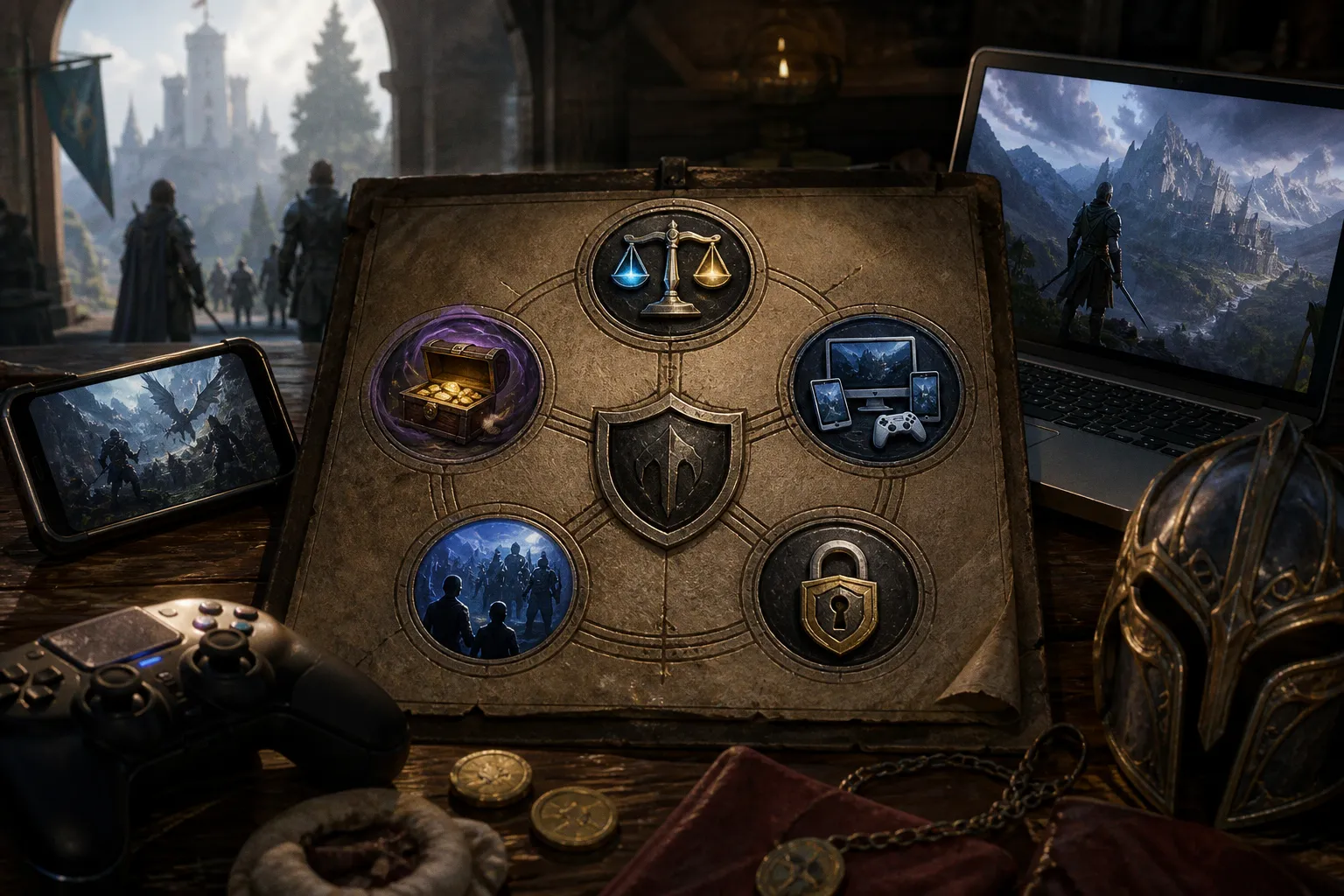
Over 90% of free-to-play titles run some form of microtransaction economy. Not all of them are predatory, but enough are that walking in blind is the single biggest tactical mistake you can make. We've all done it — sunk thirty hours into a progression system only to discover the endgame is locked behind a gacha wall or a $50 pack that invalidates your grind. The math is brutal: a few minutes of due diligence before account creation saves you dozens of hours of regret later.
Here's the five-point checklist we run through before committing to any F2P MMO. Treat it like an ROI analysis for your playtime.
1. Identifying Pay-to-Win Mechanics in the Cash Shop
This is the first and most critical filter. A cash shop isn't inherently bad — cosmetics fund servers and keep the lights on. The problem starts when items in that shop grant direct statistical advantages: increased damage output, exclusive defensive gear, accelerated leveling buffs, or crafting materials that can't be earned through gameplay at a reasonable rate.
How to check before you even create an account:
- Search the game's subreddit or forums for "P2W" discussions within the last 90 days. Older threads are worthless — monetization models shift with patches.
- Check if the cash shop is visible on the game's website or launcher without logging in. Legitimate titles have nothing to hide; opaque shops are a red flag.
- Look for "convenience" items that blur the line — things like inventory expansion, XP boosters, or respawn tokens. These aren't strictly pay-to-win, but they reveal the developer's monetization philosophy.
If the only path to competitive gear runs through the cash shop, you're not playing a game — you're funding someone else's spreadsheet.
The optimal approach is to compare the time-gated free route against the paid shortcut. If a piece of gear takes 200 hours to earn for free but costs $5 to skip, that's the developer pricing your time at $0.025/hour. That tells you everything about who this game is designed for.
| Signal | Cosmetic-Only Shop | Soft P2W | Hard P2W |
|---|---|---|---|
| Stat-boosting items | None | Available but earnable in-game | Cash shop exclusive |
| Gear progression | Gameplay only | Accelerated via cash | Gated behind payment |
| Competitive viability | Full access without spending | Mild disadvantage at top tier | Impossible to compete without spending |
| Community sentiment | Generally positive | Mixed, "it's not that bad" | Mass complaints, declining population |
Don't fall for the "you can earn everything for free technically" defense. The question isn't whether you can — it's how many hundreds of hours the free path demands compared to the paid one.
2. Analyzing Progression Systems and Gacha Transparency
Gacha mechanics are the loot box evolution, and they're now standard in a significant portion of F2P MMOs. The issue isn't randomness itself — MMOs have always leaned on RNG drops — but the opacity of the system and whether pity mechanics exist.
Before signing up, verify these specifics:
1. Published drop rates. Many jurisdictions now require gacha odds disclosure. If a game doesn't display rates prominently, assume they're unfavorable.
2. Pity system presence. A pity timer guarantees a high-rarity pull after X attempts. Games without one are mathematically designed to exploit variance.
3. Character/weapon locking. If top-tier characters or weapons are gacha-exclusive with no alternative acquisition path, the progression ceiling is directly tied to your spending tolerance.
4. Duplicate handling. What happens when you pull a duplicate? Some games convert them to useful currency; others treat them as dead weight, forcing more pulls.
The casual player sees a flashy banner and pulls. The optimized player calculates the expected cost to guarantee the desired outcome — and compares it against their time investment. If guaranteeing a single S-tier character requires 180 pulls at $3 each, that's a $540 character. Frame it that way, and the decision becomes clear.
A gacha system without published rates and a pity counter isn't a game mechanic — it's a black box designed to keep you pulling.
We're not saying avoid all gacha games. Some of the best F2P experiences right now use gacha responsibly with transparent systems. The key is checking before you're emotionally invested in a pull.
3. Verifying Account Security and Multi-Factor Authentication
This is the one most players skip entirely, and it's the one that costs the most when it fails. Your F2P MMO account accumulates value over time — characters, gear, cosmetics, and potentially linked payment methods. If the game doesn't offer Multi-Factor Authentication (MFA), you're leaving that investment unprotected.
What to verify before account creation:
- MFA availability. Check the game's support or FAQ page for two-factor authentication. This should be a non-negotiable requirement. SMS-based 2FA is acceptable; authenticator app support is better; hardware key support is ideal.
- Login notification systems. Does the game alert you when a new device accesses your account?
- Account recovery options. If you lose access, how painful is the recovery process? Games that require government ID verification for recovery are actually doing you a favor — it means unauthorized access is harder too.
- Linked account exposure. If the game uses third-party logins (Google, Steam, Discord), understand what permissions you're granting.
Industry standard for account security in 2024–2025 is MFA availability, yet a surprising number of browser-based MMOs still don't offer it. If you're about to invest hundreds of hours into a progression system, the minimum due diligence is confirming your account can be locked down properly.
Think of it this way — you wouldn't invest in premium equipment without checking the specifications and warranty first. The same principle applies to your digital accounts. Just as you'd research auto electronics and security systems before a major purchase, verify that your MMO account has the basic security infrastructure before you start building value in it.
4. Assessing Server Population and Matchmaking Health
A free-to-play MMO without players is a single-player game with extra steps. Server population directly impacts queue times, matchmaking balance, guild availability, economy health, and whether the developer will keep the lights on in six months.
How to evaluate before committing:
- Steam Charts / active player trackers. If the game is on Steam, check concurrent player counts and trends. A game trending downward for three consecutive months is in trouble.
- Server browser / queue time reports. Browse recent forum or Reddit posts about wait times. For competitive modes, anything over 3–5 minutes average queue time signals population problems.
- Regional server availability. If you're connecting to a server across the ocean, your latency compounds every interaction. Check ping requirements for the game's combat system — action MMOs need sub-80ms; tab-target systems can tolerate higher.
- "Time-to-match" in competitive modes. For battle royales and arena games, this is the single most telling metric. Long queues mean either low population or terrible matchmaking algorithms — both are dealbreakers.
| Population Health | Signs | Recommended Action |
|---|---|---|
| Thriving (50k+ concurrent) | Instant queues, active economy, frequent updates | Safe to invest time |
| Stable (10k–50k concurrent) | Minor queue times during off-peak, stable guild scene | Viable, but monitor trends |
| Declining (1k–10k concurrent) | Noticeable queues, server merges announced | Short-term only, don't grind long-term |
| Critical (<1k concurrent) | 10+ minute queues, abandoned features, no new content | Avoid — shutdown risk is real |
The ROI on grinding a character in a dying server is zero. We've seen too many players hit max rank in a game only to watch it sunset three months later. Check population trends first.
5. Evaluating Cross-Platform Compatibility and Progression
Cross-play and cross-progression are increasingly standard, but they're not universal. If you game across multiple devices — PC at home, mobile on commute, console with friends — the platform story of your next MMO matters more than you think.
The three questions to answer:
1. Is cross-play supported? This determines whether you can play with friends on other platforms. Some games support cross-play between PC and console but exclude mobile, or vice versa.
2. Is cross-progression supported? Cross-play without cross-progression means you're maintaining separate accounts per platform. Your time investment fragments.
3. Are there platform-specific restrictions? Some games disable certain features on mobile (trading, competitive ranked) or have different update schedules per platform, creating version parity gaps.
For browser-based MMOs specifically, check whether the browser version is a full client or a limited companion app. Many games advertise "play in your browser" but deliver a stripped-down experience that doesn't reflect the actual game.
The optimal play is to identify your primary platform, verify the full feature set is available there, and then confirm cross-progression exists if you plan to use a secondary device. Don't assume — confirm.
Cross-play means you can play together. Cross-progression means your time counts wherever you play. The difference is everything.
TL;DR: The Pre-Registration Priority Stack
Here's the decision framework, ordered by impact:
1. Cash shop transparency — If you can't verify the monetization model is fair in five minutes of research, walk away. Hard P2W isn't worth your time at any price point.
2. Gacha mechanics and pity systems — No published rates, no pity counter, no commitment from you.
3. Server population trends — A declining playerbase is a countdown timer on your investment.
4. Account security (MFA) — Non-negotiable for any game where you'll spend more than 10 hours.
5. Cross-platform support — Important if you're multi-device; irrelevant if you're PC-only.
The five minutes it takes to check these five data points before account creation will save you from the thirty-hour trap of discovering you've been grinding in a system designed to extract rather than reward. Min-max your onboarding, not just your endgame.