Retro games online play: keyboard and controller configuration
Retro games online play is wonderfully immediate when it works: one tab, one quick click, and you are back in an arcade cabinet, a 16-bit platformer, or a classic Flash brawler. The snag usually arrives about ten seconds later.
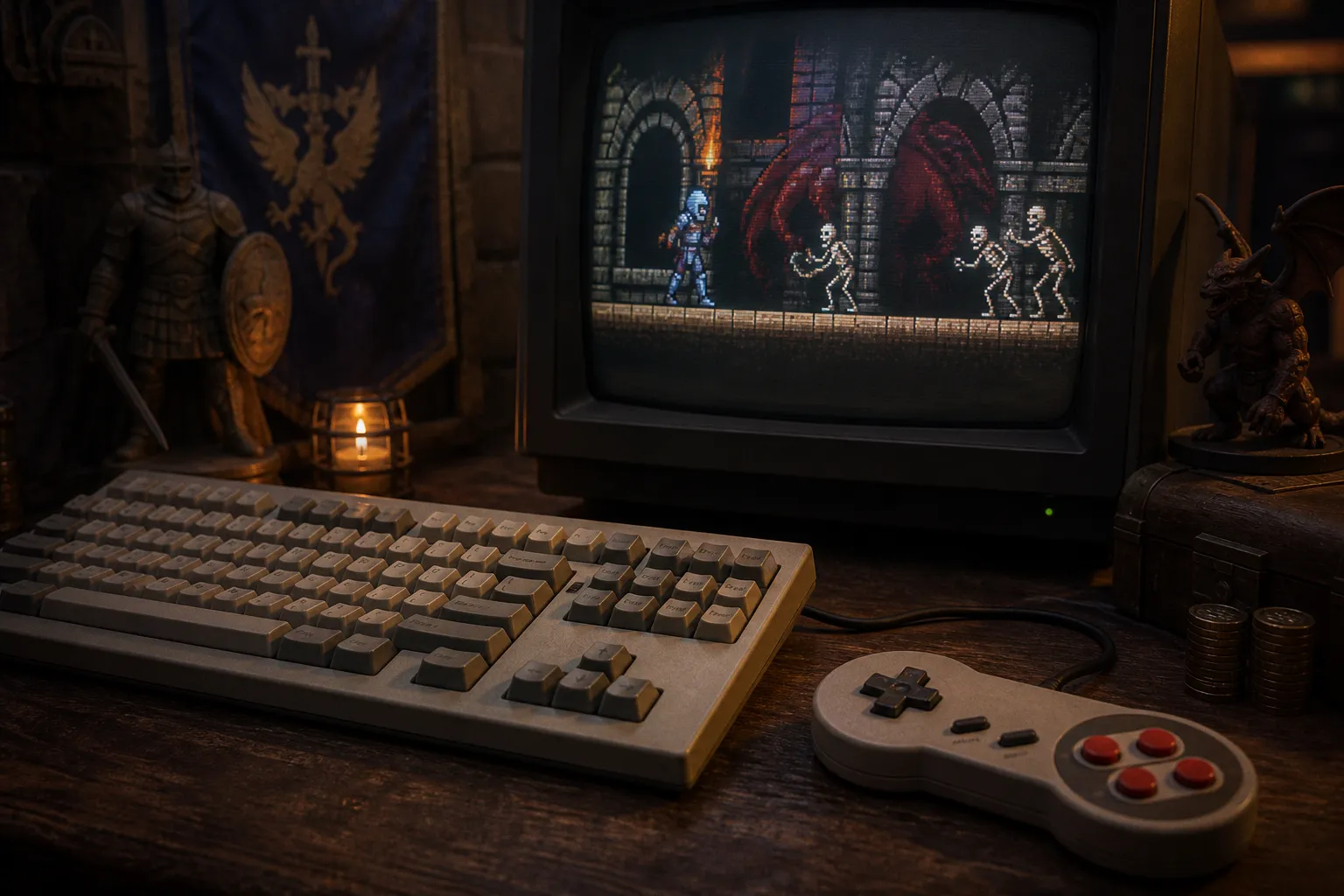
Your character will not move, the coin button is a mystery, or your controller lights up beautifully while doing absolutely nothing.
I have found that most browser-emulator input problems are not really “broken controls.” They are mismatched expectations. Internet Arcade titles speak MAME-style arcade inputs. RetroArch’s web player has its own menu layer and controller logic. Ruffle runs old Flash games that were often designed for a keyboard first, with controller support varying from site to site. Once you know which layer is listening for your key press, the whole experience becomes much more fluid.
The fastest route back into a retro game is not a perfect setup. It is knowing the one or two inputs that get the game moving.
Start with the controls the original game expects
Before remapping anything, give the default keys a fair try. Classic games were built around very specific control assumptions, and replacing those controls too early can turn a snappy arcade layout into a confusing tangle.
For most online retro emulator controls, click once inside the game window first. This sounds almost too basic, but browsers need to know where your keyboard input should go. If you have just used the address bar, scrolled the page, or clicked a menu outside the game frame, the emulator may not have focus.
Then try the expected defaults:
| Platform or emulator | Common default inputs | What they usually do |
|---|---|---|
| Internet Arcade / MAME-style titles | Arrow keys | Move through menus and control the character or vehicle |
| Internet Arcade / MAME-style titles | 5 | Insert a virtual coin |
| Internet Arcade / MAME-style titles | 1 | Start a one-player game |
| Internet Arcade / MAME-style titles | 2 | Start a two-player game |
| RetroArch Web Player | Keyboard or detected gamepad | Depends on the loaded core and game |
| RetroArch Web Player | F1 | Open the Quick Menu |
| Ruffle Flash games | Usually arrows, WASD, Space, Ctrl, or mouse | Depends on the original Flash game |
That 5 then 1 rhythm is particularly useful for arcade games. A title can look frozen on its attract screen when it is actually waiting for a coin and a Start press, exactly like the original cabinet. You will notice this most often in fighting games, beat ’em ups, racing games, and vertical shooters.
Do not assume the label on screen will match your modern controller habits, either. In an old arcade game, “Button 1” might be punch, fire, accelerate, or jump. “Button 2” may be kick, brake, or bomb. Spend the first minute tapping buttons deliberately rather than mashing through the opening round. It saves a surprising number of accidental credits and menu exits.
Navigating the Internet Arcade: MAME controls and configuration
The Internet Arcade runs classic arcade software through JSMESS, a browser-based JavaScript port connected to the MESS and MAME emulator projects. That background matters only because it explains the control feel: you are dealing with arcade-machine conventions, not a modern web game’s tidy settings screen.
The basic sequence is straightforward:
1. Click the game window so it has keyboard focus.
2. Press 5 to add a virtual coin.
3. Press 1 for single-player or 2 for two-player.
4. Use the arrow keys for direction.
5. Test the action keys shown by the game, or open the emulator configuration if the defaults are awkward.
For configuration, press Tab. This opens MAME’s on-screen menu, where you can find input assignments and rebind individual actions. It is handy when an old title places an essential move on a key that your browser, operating system, or hands do not enjoy.
I usually remap only the controls that block play. For a fighting game, that might mean moving attacks closer together. For a shooter, it might mean putting fire and bomb on adjacent keys. There is no prize for recreating a cabinet’s full control panel on a laptop keyboard. The goal is an intuitive loop: move, act, react, repeat—without looking down every few seconds.
There is one small catch that catches nearly everyone: Internet Arcade custom mappings do not survive a browser refresh. Treat them as a session setup, not a permanent profile. If you find a layout that feels excellent, make a quick note of it before closing the tab. The next visit may require the same thirty seconds of setup again.
A practical MAME keyboard layout for laptop play
For many arcade games, I find this arrangement comfortable because it keeps both hands relaxed and leaves the arrow keys free for movement:
- Arrow keys: movement or menu navigation.
Z,X,C: the first three action buttons, ideal for fighters and shooters.A,S: extra actions when the game needs more than three buttons.Enter: a useful alternative Start key if the game’s configuration allows it.5: coin insert, left untouched so it remains easy to remember.
This is not a universal recipe. A driving game may feel better with different keys, and a twin-stick-style arcade title can demand more experimentation. But it gives you a clean starting point instead of turning every key on the keyboard into a mystery button.
Manage RetroArch Web Player inputs one layer at a time
RetroArch Web Player is a different creature. It is compiled for the browser with Emscripten and supports gamepad input through the SDL2 library. In plain terms, it is often more controller-friendly than a typical Flash page, but it also has more layers: browser, RetroArch interface, emulator core, and game.
That sounds busier than it feels in practice. The key is to separate a game-specific problem from a RetroArch-wide problem.
If your controls work in the menu but not during gameplay, open the Quick Menu with F1. From there, you can access remapping options for the active emulator core. This is the place to adjust a button layout when, for example, a console game expects one face-button order but your controller muscle memory expects another.
A sensible workflow looks like this:
1. Connect the controller before loading the game. Browsers are generally better at detecting a gamepad that is already awake and connected.
2. Click the RetroArch player area. This makes sure your key presses are not landing in the browser page.
3. Test the directional pad and face buttons in the game menu. A responsive menu tells you the browser and player have detected something.
4. Press F1 for the Quick Menu if the in-game mapping feels wrong.
5. Remap only the actions that feel misplaced. Preserve the rest until you know the game’s original layout.
6. Return to the game and test movement, confirmation, cancel, and the main action button.
The detail worth remembering is that a controller being detected is not the same as every game feeling right. Different console families placed confirm and cancel actions in different spots. Arcade ports also rearranged functions between regions and platforms. If “Back” keeps acting like “Confirm,” your controller is not malfunctioning; the button order simply needs a quick adjustment.
A controller setup is good when you stop thinking about the controller and start reading the game’s timing again.
Keyboard or controller: which feels better?
For browser retro gaming, I do not automatically recommend a controller. The best option depends on the game’s original rhythm.
| Game type | Keyboard tends to shine when… | Controller tends to shine when… |
|---|---|---|
| Arcade shooters | You need quick access to one or two fire buttons | The game uses several actions or benefits from a D-pad |
| Fighting games | You are practicing a simple layout and want immediate input | You prefer a pad’s directional control and clustered buttons |
| 8-bit and 16-bit platformers | You are playing casually with a compact key layout | You want smoother long sessions and familiar console spacing |
| Racing games | The game uses left/right steering and basic acceleration | You want trigger or analog-stick options where supported |
| Puzzle games | Arrows and a couple of keys cover everything | You are already comfortable navigating with a D-pad |
| Flash games | The title was built around WASD, arrows, mouse, or number keys | The hosting site has explicitly added controller support |
For a quick five-minute run, a keyboard is often the cleanest answer. For longer sessions with platformers, console RPGs, or arcade compilations, a controller can make the experience much less cramped. I keep both options in mind rather than treating one as the “real” way to play.
Fix browser and operating-system shortcuts before fighting the emulator
Sometimes the emulator is perfectly configured and the computer is simply intercepting the key first. This is where retro games online play gets mildly annoying—but also very fixable.
The most common warning signs are easy to spot:
- Pressing an arrow key scrolls the webpage instead of moving your character.
Tabjumps through browser interface elements rather than opening the MAME configuration menu.- A browser shortcut refreshes, zooms, or changes focus just as you try to use an in-game command.
- A key works once, then disappears after you click outside the player.
- A controller responds in one browser tab but not another.
Start with the least dramatic fixes. Full-screen mode often reduces accidental page scrolling and makes the player feel more like a proper game screen. Clicking directly inside the game window restores focus. Closing a text field, search box, or open browser menu can also return your keyboard to the emulator.
macOS players have one especially specific issue to watch for. Default Internet Arcade controls can overlap with Mission Control shortcuts, particularly combinations involving the Left Control key and arrow keys. If a movement input keeps triggering a desktop-level action, change or disable the conflicting Mission Control shortcut in macOS system settings. Do not keep remapping the game around an operating-system shortcut if the operating system is the real culprit.
Ruffle has its own reserved-input wrinkle. The emulator traps certain keyboard inputs, including Ctrl+R, Tab, Page Down, and Page Up. That is usually done to keep the browser from hijacking a Flash game’s controls, but it means a familiar browser habit may not behave as expected while the game has focus.
This matters most in old Flash games with a long key list. A multiplayer arena game might use number keys for weapons, Tab for scoreboards, and Ctrl for a special action. Take a moment to read the game’s own controls page or opening screen before assuming the browser is stuck. Flash-era games loved hiding a useful move behind one odd key, and that weirdness is part of the preservation package.
Ruffle and Flash games: do not expect universal controller mapping
Ruffle is a Rust-based Flash Player emulator that runs on the web through WebAssembly. It has made an enormous amount of old browser-game history playable again after Adobe Flash Player reached end-of-life in 2020. But its input philosophy is still rooted in the original Flash experience: keyboard and mouse first.
That means there is no one universal retro game controller setup browser menu that works across every Ruffle game on every site. Some platforms build their own controller mapping layer. Some use JavaScript Gamepad APIs through additional tools such as RufflePad. Some games simply remain keyboard-only because that is how the ActionScript game was designed.
Here is the useful way to approach a Ruffle title:
1. Try the original keyboard layout first. Arrow keys, WASD, Space, Ctrl, Shift, and mouse clicks cover a huge share of classic Flash games.
2. Look for site-specific controller settings. If a host offers them, use that layer rather than expecting Ruffle itself to expose identical options everywhere.
3. Test menus separately from gameplay. A controller may navigate a host’s overlay while the embedded Flash game still expects keys.
4. Keep keyboard fallback nearby. Even games with partial controller support may use keyboard-only keys for pause, inventory, chat, or level editors.
5. Avoid browser extensions that promise automatic mapping for every game. There is no universal solution that reliably translates every controller to every web emulator without some manual setup.
I find that Flash platformers, action games, and puzzle titles often feel great on a keyboard once you accept their original layout. The controls can be surprisingly snappy because the designers expected players to use them every day in school computer labs and browser portals. The awkward cases are usually games that combined mouse aiming with keyboard movement, or titles with a giant collection of hotkeys.
Keep a small troubleshooting routine for repeat visits
The final frustration with playing retro games in a browser is persistence—or the lack of it. An emulator may forget your mapping after a refresh. A browser may ask for controller permission again. A game page may load with focus somewhere else. None of this means your setup failed; browser play is simply more session-based than a dedicated desktop emulator.
When a control layout suddenly stops behaving, I run through this compact sequence:
1. Refresh only after noting any custom mapping. Internet Arcade remaps reset on refresh, so do not wipe out a working layout by accident.
2. Reconnect the controller and reload the player. Especially useful if the controller was plugged in after the page opened.
3. Click the game frame before testing keys. Focus is the quiet culprit behind a lot of “nothing works” reports.
4. Try the original defaults. For an arcade title, use 5, then 1, then arrows. For RetroArch, check F1. For Flash, try the controls listed by the game itself.
5. Disable only the shortcut conflict you can identify. Do not overhaul your entire operating-system keyboard setup for one old game.
6. Test in another modern browser if the input layer remains unresponsive. This can quickly reveal whether the issue is browser-specific rather than game-specific.
The good news is that once your setup clicks, browser emulation has a wonderfully low-friction loop. You can jump from a coin-op shooter to a console platformer to a Flash classic without downloads, installers, or a shelf full of aging hardware.
For your next session, I would pair these control habits with three very different kinds of games: a simple two-button arcade shooter to learn the 5 and 1 routine, a 16-bit platformer in RetroArch to tune a controller’s feel, and a keyboard-first Flash action game in Ruffle. Each one teaches a different input language. After that, the chaotic old web starts feeling less like a pile of mysterious controls and more like the lively game library it has always been.