What is an MMORPG? Common beginner mistakes fixed
If you are asking “what is MMORPG games?” because a friend invited you to a server, a launcher promised a free-to-play fantasy world, or a browser MMO dropped you into a town full of glowing quest…
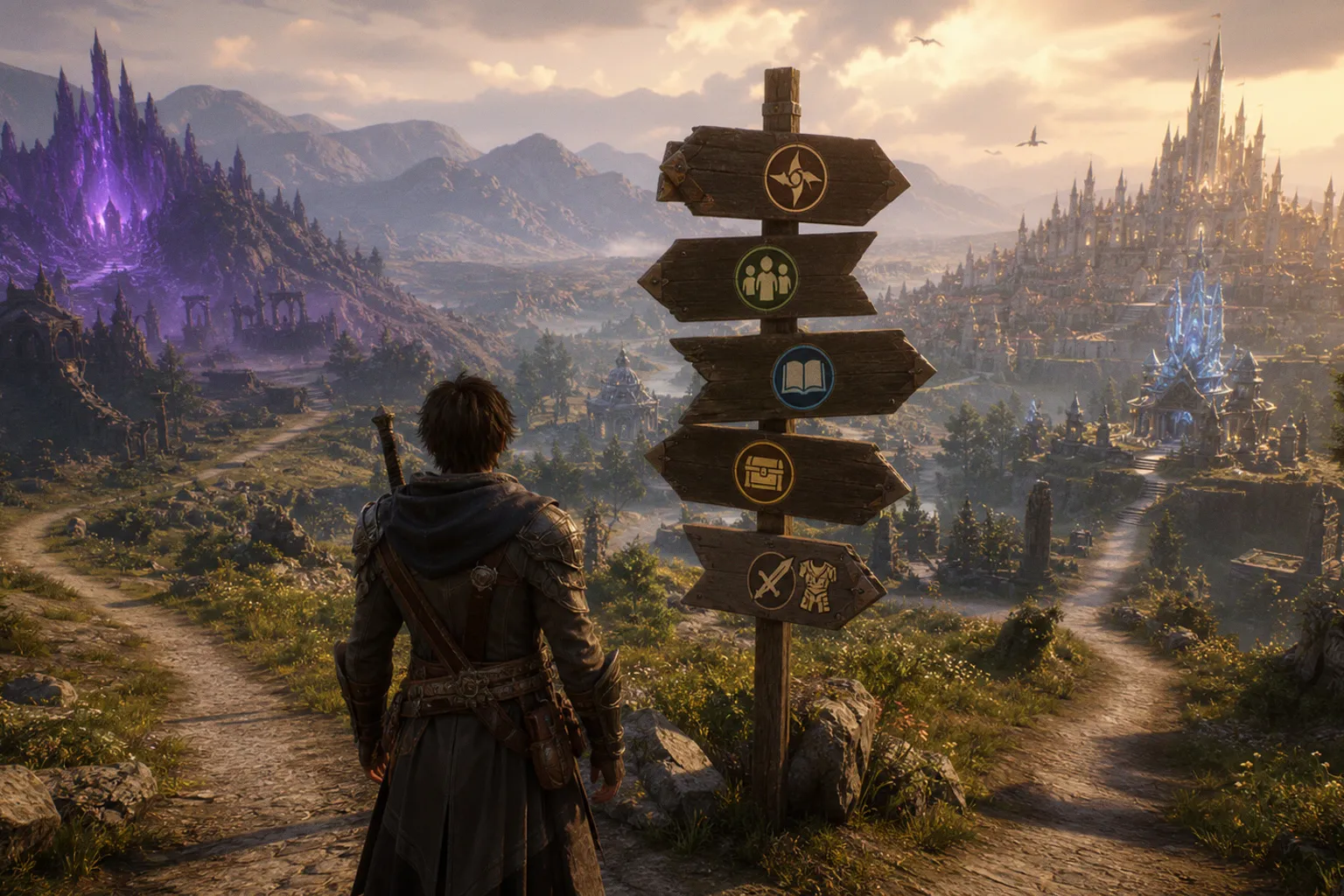
If you are asking “what is MMORPG games?” because a friend invited you to a server, a launcher promised a free-to-play fantasy world, or a browser MMO dropped you into a town full of glowing quest markers, the short answer is this: an MMORPG is an online role-playing game where thousands of players share a persistent world, grow characters over time, and bump into the same economy, dungeons, guilds, events, and social chaos.
The time commitment is the part beginners often underestimate. You can taste an MMORPG in 20 minutes: make a character, run a few quests, swing a sword, cast a spell, maybe get your first pair of boots with suspiciously better stats. But understanding the loop takes a few sessions. The genre is less about “beating the game” and more about settling into a rhythm: explore, level, unlock skills, upgrade gear, group up, learn your role, repeat — ideally without turning the whole thing into homework.
MMORPG meaning: the game world keeps moving when you log off
MMORPG stands for Massively Multiplayer Online Role-Playing Game. That sounds bulky, but each piece earns its seat at the table.
- Massively multiplayer means you are not just in a four-player lobby. You are sharing the world with a large player population, whether that means crowded cities, server-wide events, trading markets, guilds, raids, or public zones where strangers wander into the same fight.
- Online means the world lives on servers. Your character, inventory, progress, and social connections exist beyond a single local save file.
- Role-playing game means your character develops through levels, abilities, gear, story choices, class identity, crafting, builds, or some blend of those systems.
- Persistent world is the secret sauce. The world does not reset every match the way a battle royale arena does. You log out, come back tomorrow, and your character still has that sword, that mount goal, that dungeon unlock, and yes, that bag full of crafting junk you swore you would sort later.
The term MMORPG was coined in 1997 by Richard Garriott, creator of Ultima Online, to describe graphical online role-playing games that had grown out of the older graphical MUD tradition. The genre had roots before that — Neverwinter Nights on AOL arrived in 1991, Meridian 59 appeared in the mid-1990s, and EverQuest in 1999 helped shape the template many players still recognize. Then World of Warcraft in 2004 blasted the idea into the mainstream.
You will notice that modern free-to-play MMOs can look wildly different from each other. Some are classic fantasy worlds with tanks, healers, and damage dealers. Some lean into action combat. Some run in browsers with lighter systems and faster loops. Some borrow from gacha games, survival sandboxes, or competitive arenas. The connective tissue is not the art style or even the combat speed. It is the long-running shared world and the character growth that gives your play sessions a little memory.
An MMORPG is not just a big RPG with chat. It is a living loop: character growth, shared space, social friction, and a world that keeps its receipts.
MMO vs MMORPG difference: not every massive game is an RPG
The MMO vs MMORPG difference is simple once you separate scale from role-playing progression.
An MMO is any massively multiplayer online game. That umbrella can include racing worlds, social hubs, survival games, shooters, virtual spaces, and browser arenas. An MMORPG is a specific kind of MMO built around RPG-style character progression.
Here is the clean version:
| Feature | MMO | MMORPG |
|---|---|---|
| Core idea | Many players online in a shared system | Many players online in a persistent RPG world |
| Progression | May be cosmetic, seasonal, rank-based, or minimal | Usually character levels, skills, gear, classes, quests, and builds |
| World structure | Can be match-based, hub-based, open world, or event-driven | Usually persistent zones, cities, dungeons, raids, economies, and story arcs |
| Player identity | Often tied to account, rank, or avatar | Strongly tied to a character or class role |
| Common examples by style | Battle royale, social sandbox, online racing, virtual world | Fantasy MMORPG, sci-fi MMORPG, sandbox RPG world, browser RPG MMO |
This matters because beginners sometimes enter an MMORPG expecting the snappy reset of a match-based game. They want immediate balance, instant access to every tool, and no long tail. That is not usually how the genre breathes. MMORPGs are built around accumulation: your map knowledge, class comfort, gear habits, friend list, crafting stash, and dungeon confidence all stack up.
That does not mean the genre has to be slow or punishing. A good free online MMORPG gives you satisfying micro-wins early: a new ability, a faster mount, a cleaner rotation, a first dungeon clear, a smarter inventory setup. But the payoff is layered. The best sessions feel fluid because small decisions keep feeding the larger loop.
How to play MMORPG games without burning out in the first week
The most common beginner mistake is rushing straight toward the endgame. I get the urge. Veteran players talk about raids, ranked modes, legendary gear, seasonal bosses, and “real content” like everything before max level is a waiting room with wolves in it.
That mindset can flatten the whole experience.
Leveling is where an MMORPG teaches you the feel of your character. Not in a dry tutorial way, but through repetition that slowly becomes intuitive. You learn which ability starts a fight cleanly, which cooldown saves you when three enemies pile on, when to move, when to interrupt, when to heal, when to stop looting every cracked claw from every cave spider. If you skip the learning curve mentally, even if the game lets you speed through it mechanically, you arrive later with a character you technically own but do not really understand.
A better first-week rhythm looks like this:
1. Pick one character and let the controls settle. You do not need the mathematically perfect class. You need one that feels good under your fingers. If the movement is snappy, the attacks have a clean read, and the role makes sense to you, stay with it long enough to learn the loop.
2. Follow the main path before scattering into every side activity. Most MMORPGs use main quests to unlock dungeons, travel systems, features, and core mechanics. In Final Fantasy XIV, for example, the Main Story Quest and blue unlock quests carry major content gates, while clearing every standard yellow side quest early is usually inefficient.
3. Read skill tooltips when a new ability appears. Not for a thesis. Just enough to know whether it starts a combo, spends a resource, heals you, controls enemies, or belongs in emergencies. Your hotbar should feel like a small toolkit, not a piano that fell down the stairs.
4. Upgrade gear in small, steady steps. Do not wait until combat feels miserable. If enemies take forever to die or your health drops too fast, your gear may be lagging behind your level.
5. Try one group activity earlier than feels comfortable. A dungeon, world event, guild mission, public boss — something with other players. You will learn more from one slightly messy run than from ten isolated fetch quests.
The endgame will still be there. MMORPGs are very good at inventing more endgame. What you cannot easily recover is the early sense of discovery if you turn the first 30 hours into a sprint fueled by other people’s urgency.
If you rush an MMORPG only to “start playing later,” you may skip the exact part that teaches your hands how the game wants to be played.
The class quest problem: your character may be missing half its toolkit
One of the sneakiest common MMORPG mistakes is ignoring class-specific quests. They often look optional because they sit beside the main path, but in many games they are not fluff. They are how your character becomes the thing you chose on the character creation screen.
In Final Fantasy XIV, Job Quests from levels 1–70 unlock more than 50% of a character’s abilities. That is enormous. Skipping them does not just mean missing a bit of lore or a cute outfit. It can mean walking into combat without skills the game expects you to have. Some of those quests also provide useful gear upgrades, which makes the problem double: weaker toolkit, weaker stats.
This is where beginners get trapped. The game may still let you queue, quest, and wander. Your character still swings a weapon. The screen still fills with numbers. But the feel is off. Fights drag. Your role feels strangely thin. Other players seem faster, smoother, almost unfairly efficient.
Often, the missing piece is not talent. It is an unlock.
A simple habit fixes most of this: every few levels, check whether your class, job, or profession trainer has something waiting. Different MMORPGs label these systems differently. You might see class quests, job quests, specialization quests, skill unlocks, advanced training, awakening quests, ascension quests, or role quests. The name changes; the principle does not.
When I start a new MMORPG, I treat these as part of the main road, not a side alley. Main story teaches the world. Class quests teach the character. Skip either one and the game becomes less fluid than it should be.
A beginner’s priority map for quest types
Not all quest markers deserve the same attention. That glowing icon over a farmer’s head may be charming, but it may not be the best use of your first night.
| Quest type | What it usually unlocks | Beginner priority |
|---|---|---|
| Main story quests | Zones, dungeons, mounts, systems, major progression gates | Very high |
| Class/job quests | Abilities, role tools, gear, class identity | Very high |
| Blue/unlock-style quests | Features, optional dungeons, mechanics, travel options | High, especially when they unlock systems |
| Daily quests | Currency, reputation, repeat rewards | Medium; useful once you understand the loop |
| Standard side quests | XP, small rewards, world flavor | Selective; enjoy them, but do not drown in them |
| Event quests | Limited rewards, cosmetics, seasonal activities | Depends on timing and interest |
This is not a command to ignore story flavor. Some side quests are lovely, funny, or quietly excellent. But if your goal is to learn how to play MMORPG games without feeling lost, the early priority is unlocks first, completionism later.
Inventory clutter: the bag monster always wins unless you build habits
Every MMORPG eventually introduces you to a second enemy faction: your own inventory.
At first, every drop feels precious. A wolf pelt, an herb, a cracked gem, a low-level sword with a green name, twelve crafting materials you do not recognize — surely these matter later, right? Sometimes they do. Often they are vendor trash, salvage fodder, auction house material, or low-tier ingredients the game throws at you by the wagonload.
Beginners hoard because they lack context. That is normal. The trouble starts when the bag fills, quest rewards cannot be claimed, crafting becomes a fog, and every town visit turns into five minutes of reluctant item archaeology.
Different MMORPGs solve this in different ways. Guild Wars 2, for example, has material storage with a default capacity of 250 per resource, and the “deposit materials” habit is one of those tiny quality-of-life moves that makes the whole game feel cleaner. Other games lean on salvaging, vendor selling, banks, retainers, trading posts, auction houses, or crafting bags.
The goal is not to become an economy goblin on day one. The goal is to keep your play session snappy. Inventory management should support the adventure, not eat it.
A workable early routine:
- Sell obvious junk every time you reach a town. If an item is labeled junk, trash, gray, broken, or “sell to vendor,” believe the game.
- Store crafting materials using the game’s dedicated system. Material banks, crafting bags, reagent storage, and deposit buttons exist because MMO loot tables are generous little chaos machines.
- Salvage gear you have outgrown if the game rewards it. Some MMOs turn old equipment into materials, upgrade components, or crafting progress.
- Check the trading post or auction house before vendoring rare-looking drops. You do not need to price every pebble, but tradeable crafting materials and uncommon drops can be worth more to players than to NPC vendors.
- Do not keep every low-level weapon “just in case.” If you cannot equip it, will not use it for a known build, and it has no special unlock value, let it go.
The same applies to currency bloat. Modern free-to-play MMOs love tokens: dungeon coins, event leaves, arena medals, daily seals, reputation shards, seasonal candy, premium-adjacent gems, and little icons that look important because they are purple. Before you panic, hover over them. Most will tell you where they are spent. If not, search the in-game vendor list or ask chat. A quick answer saves a messy bag.
Gear maintenance: your weapon is not decoration
Gear in an MMORPG is not just fashion, though fashion may become the true endgame if you stay long enough. Equipment controls your damage, healing, defense, survivability, and sometimes the entire feel of a class. Beginners often notice armor upgrades but forget the main-hand weapon, which is usually the biggest single lever for combat output.
In Final Fantasy XIV, a practical rule is to keep your main-hand weapon within about 5 levels of your class level. Let it fall too far behind and combat starts to feel gummy. Enemies survive too long. Heals feel thinner. Your rotation may be correct, but the numbers refuse to sparkle.
This is one of those places where “skill issue” talk gets unhelpful. If your weapon is badly outdated, no amount of enthusiasm makes the fight fluid. You are pushing the right buttons through a clogged pipe.
For most beginner-friendly MMORPGs, use this light gear rhythm:
1. After every major level milestone, inspect your weakest slot. Weapon first, then armor pieces that are many levels behind.
2. Equip quest rewards that clearly improve your main stats. Early on, simple upgrades usually beat theoretical build planning.
3. Do not spend rare upgrade materials on disposable low-level gear unless the game showers you with them. Save scarce resources until you understand how often equipment gets replaced.
4. Replace your weapon before replacing tiny stat accessories. A ring upgrade may feel nice. A weapon upgrade usually changes the pace of combat.
5. Repair gear if the game uses durability. It sounds boring until your armor breaks mid-dungeon and your brave hero becomes a paper lantern.
Some older or classic-style MMORPGs make economy planning part of gear progression. In WoW Classic, for example, a mount at level 40 costs 100 gold, which makes casual spending matter. That does not mean you need to play like an accountant. It does mean that buying every shiny auction house weapon while leveling can delay mobility upgrades that make the whole world feel better.
Social systems are not extra decoration
Many modern MMORPGs support solo play better than the old days did. Some even include systems that let you run story dungeons with NPC allies. That is good. Solo-friendly design helps players who have odd schedules, social anxiety, limited time, or a simple preference for quiet exploration.
But playing entirely solo forever can make the genre feel smaller than it is.
The cooperative layer is not just about raids. It is the tiny, useful stuff: someone answering a build question, a guildmate crafting a starter item, a stranger reviving you after a world boss stomp, a group finder popping you into your first dungeon, a city chat warning everyone about an event spawn. MMORPGs are at their best when the world feels inhabited, not merely populated.
If you are nervous about grouping, start low-pressure:
- Join a casual guild or free company with beginner-friendly language. Look for “social,” “leveling,” “new players welcome,” or “chill” rather than progression-heavy requirements.
- Use group finder for normal dungeons before harder versions. Normal modes exist for learning the layout, pace, and role expectations.
- Say you are new at the start of a run. Most groups adjust quickly when they know. Silence creates more confusion than honesty.
- Watch what other players do between fights. Where they stand, when they pull, when they pause, when they skip optional mobs — this is practical knowledge the game may never explain cleanly.
- Ask one specific question at a time. “Which stat should I use?” is easier to answer than “How do I play this entire game?”
Social play also protects against burnout. A long grind feels lighter when it includes a guild chat joke, a shared goal, or a friend saying, “Queue one more?” The loop becomes warmer. Less like checking boxes, more like returning to a familiar table.
Browser MMOs and free-to-play MMORPGs: same instincts, faster access
On ubgworld.com, I spend a lot of time around games that cut out the heavy setup: browser games, unblocked games, quick multiplayer sessions, free online worlds. Browser MMOs often compress the MMORPG formula into something more immediate. You may not get the sprawling production values of a giant desktop client, but you still get the good bones: progression, shared spaces, character upgrades, repeatable activities, and that satisfying “one more task” pull.
Free-to-play MMORPGs add another layer: monetization. Not every free MMO is predatory, and not every shop item is a trap. Cosmetics, convenience boosts, battle passes, character slots, and optional subscriptions all show up in different forms. The beginner mistake is assuming that spending instantly solves confusion. It usually does not. A boosted character with a messy inventory, skipped class unlocks, outdated gear habits, and no understanding of group play is still going to feel awkward.
Before spending, ask yourself what problem you are solving:
| Temptation | Better first question |
|---|---|
| Buying a level boost | Do I understand my class well enough to enjoy higher-level combat? |
| Buying inventory space | Have I learned the deposit, salvage, vendor, and storage systems? |
| Buying gear | Will this be replaced quickly through quests or dungeons? |
| Buying cosmetics | Do I like this character enough to stick with them? |
| Buying convenience items | Is the inconvenience real, or am I still learning the interface? |
A good free-to-play loop should feel playable before your wallet enters the room. Spending can polish the experience, but it should not be the tutorial.
The clean beginner route: what to do in your first five sessions
If you want a practical path through the early fog, keep it simple. Here is how I would guide a new player through the first few sessions of almost any MMORPG, whether it is a giant client-based world or a lean browser MMO.
1. Session one: learn movement and combat feel. Make a character, complete the opening quests, and pay attention to whether movement feels fluid. Do you like ranged attacks? Melee impact? Healing? Pets? Magic? Do not overthink tier lists yet.
2. Session two: follow the main quest and unlock your first systems. Watch for any quest marker that clearly unlocks features. If the game highlights class training, do it immediately.
3. Session three: clean your bags and inspect your gear. Sell junk, store materials, equip obvious upgrades, and check your weapon level. This session may sound dull, but it makes the next one smoother.
4. Session four: try a public or grouped activity. A dungeon, event boss, arena, guild mission, or co-op quest gives you a read on the multiplayer texture. You will notice whether the game’s social rhythm clicks for you.
5. Session five: decide your direction. Story, crafting, PvP, dungeons, economy, exploration, collecting mounts, joining a guild — pick one lane to pursue for a while. MMORPGs become overwhelming when you try to swallow the whole map at once.
That last point is the real comfort trick. You do not need to understand every system immediately. You need one meaningful goal that pulls you through the next evening.
Final take: an MMORPG is a long loop, not a finish line
An MMORPG is a persistent online RPG built around shared worlds, character growth, and social momentum. The meaning is easy to define; the feel takes a little longer. You learn it through small, repeated moments: a cleaner pull, a new ability finally making sense, a bag that is not a disaster, a weapon upgrade that makes combat snap back into place, a group run that turns strangers into temporary teammates.
The beginner mistakes are fixable. Do not rush so hard that you miss the learning curve. Do not ignore class quests that unlock your real toolkit. Do not let inventory clutter turn every town stop into a swamp. Keep your weapon current. Let the social systems help, even if you mostly enjoy solo play.
If you like the idea but want a lighter first bite, start with browser MMOs or free online RPG worlds that let you feel the loop quickly. If you want deeper progression, try a full free-to-play MMORPG with strong main quests and beginner-friendly group tools. And if the first world does not click, that is fine. The genre is huge. Somewhere out there is a version with the right pace, the right combat feel, and the right little reward chime to keep you happily saying, “Alright, one more quest.”