The Crew board game missions and strategy
The Crew: The Quest for Planet Nine presents a closed cooperative system with fixed constraints: 50 sequential missions, a 40-card deck, 36 task cards, and exactly one radio communication token per player per mission.
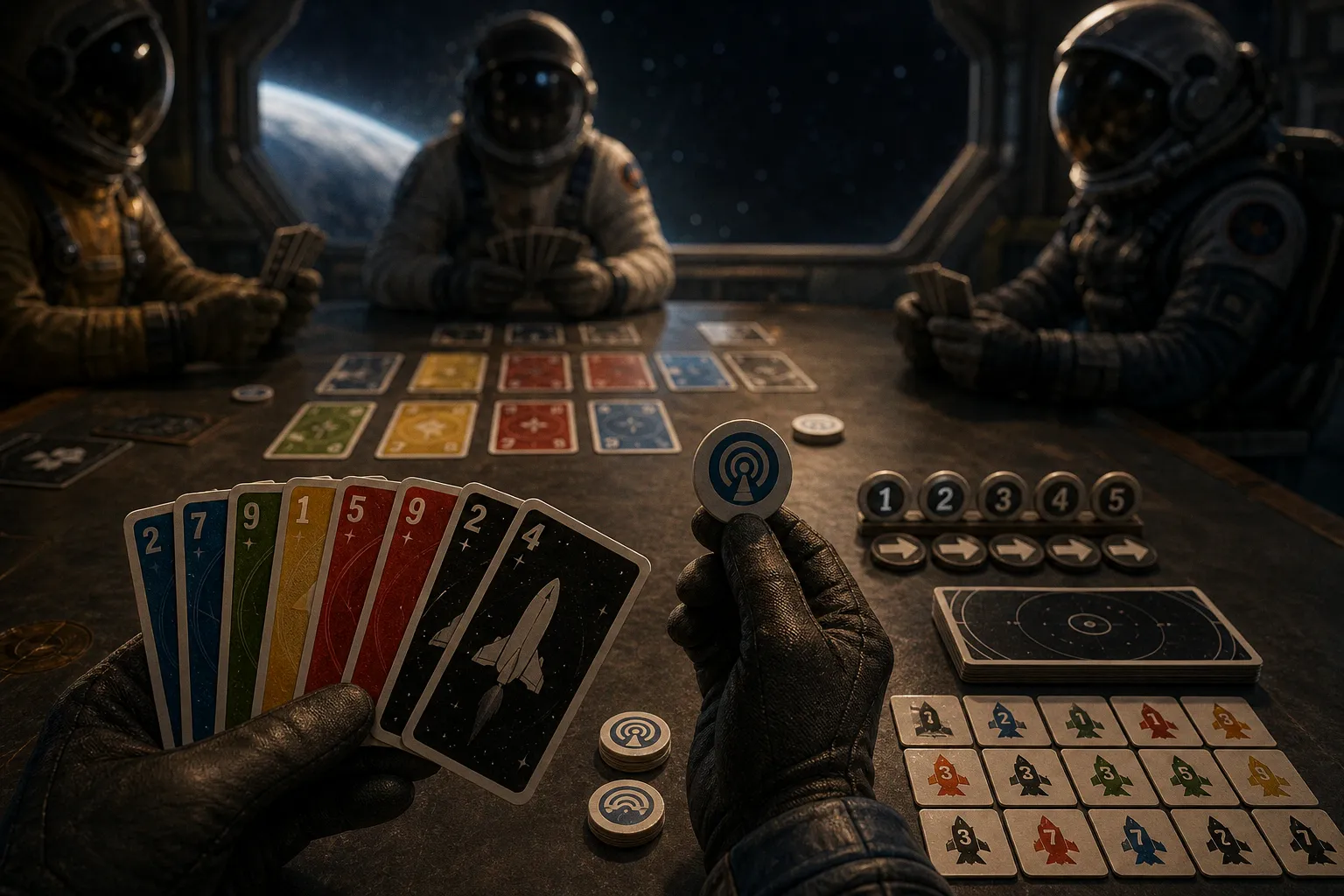
Master The Crew Board Game Missions with This Walkthrough
The 40-card deck is fixed. The information bandwidth per mission is one radio token. The remaining variable is hand distribution.
Commander Duties and the 40-Card Deck Hierarchy
The Commander for any given mission is the player who receives the Rocket card valued 4 when the deck is dealt. At the start of each mission, the entire 40-card deck is shuffled and redistributed — Rocket 4's position is random, and Commander designation rotates accordingly from mission to mission. There is no mechanism for a player to retain Commander status across consecutive missions. The role is earned fresh each deal.
The Commander executes three primary functions:
1. Starts the first trick. As the lead player of mission round 1, the Commander sets the channel (suit) for that trick.
2. Selects the first task. The Commander draws from the task deck and places the first task card face-up on the table.
3. Sets the operational tempo. The Commander's opening lead and subsequent play decisions anchor the team's information state for the duration of the mission.
The deck hierarchy is fixed. The 36 colored cards distribute across four suits (typically green, blue, yellow, and pink) with values 1–9 each. The four Rocket cards (1–4) act as permanent trump — they win any trick they enter, with Rocket 4 the highest card in the entire deck, descending through Rocket 3, Rocket 2, and Rocket 1.
Parameter Summary:
| Element | Count | Function |
|---|---|---|
| Colored cards | 36 | Channel-specific data units (values 1–9 × 4 suits) |
| Rocket cards | 4 | Permanent trump; Rocket 4 highest |
| Task cards | 36 | Mission objectives |
| Radio tokens | 1 per player | One-way signaling device per mission |
| Missions | 50 | Sequential, non-skippable |
Within a single mission, the Commander holds a dual advantage: the right to shape the opening lead and the single strongest card in the deck. This creates a recurring tension. Playing Rocket 4 early in a mission can secure a critical trick for a task, but it also surrenders the deck's most powerful card before all tasks are resolved. Late missions in Orbit 4 frequently demand that the Commander hold Rocket 4 as insurance against task conflicts that only surface in the final tricks. The decision of when — or whether — to deploy Rocket 4 is one of the highest-leverage choices in any individual mission.
Tactical Signaling with the Single Radio Communication Token
The radio token is the only legal communication channel between players. Once placed on a card, it cannot be moved, retracted, or augmented. It encodes exactly one of three states for that card:
- Highest card of that color in the player's hand.
- Lowest card of that color in the player's hand.
- Only card of that color in the player's hand.
The token cannot encode numeric value beyond an ordinal position. It cannot encode Rocket status. It cannot be used to indicate a card that the player intends to play in a specific trick. The protocol is binary: one signal, three possible states, applied to one card.
Deployment Protocol:
1. Identify the highest-leverage card. Before placing the token, evaluate which card in your hand will produce the most information asymmetry between your hand state and your visible card. Cards in colors where teammates are likely to hold extremes (1 or 9) generate stronger signals than mid-range cards.
2. Match the signal to the active task. Read the task card on the table. If the task requires winning a specific high-value card, signal "lowest" of that color to communicate that you cannot take the trick — freeing a teammate to contest it.
3. Preserve the token on missions with multiple task dependencies. Spending the token on mission 8 is often required; spending it on mission 48 when three tasks remain in play is a costly trade. Token economy is a first-class resource across the campaign.
4. Coordinate signal placement with the Commander. If the Commander's hand contains a card relevant to the task, the Commander should consider placing the token themselves to avoid redundant signaling from another player on the same suit.
Radio tokens are spendable. Each mission consumes one. There is no carry-over between missions.
The most common signaling error in mid-campaign play is token redundancy — two players signaling about the same suit, each unaware that the other has already committed. This burns the team's communication budget without adding information. Before placing your token, scan the visible state: has another player already signaled? If so, yours should target a different suit or a different task entirely. This kind of pre-commitment awareness separates Orbit 2 players from Orbit 3 players, and it becomes a survival requirement in Orbit 4.
Navigating Task Assignments and Chronological Order Tokens
The 36 task cards drive mission structure. A task requires the assigned player to win the trick containing the specific card depicted on that task. If a player is assigned multiple tasks in one mission, they must win one trick per task — but not necessarily in the order drawn unless an order token specifies otherwise.
Order Tokens appear in missions that mandate sequence. The order token set includes two categories:
- Numeric tokens (1–5): Tasks assigned these tokens must be completed in the order drawn. The player must win the trick for task 1 before attempting task 2.
- Arrow tokens: Tasks must be completed in the relative sequence specified by arrow direction. Arrows may point forward, backward, or chain between tasks.
Order tokens transform parallel task sets into serial dependencies. A mission with three tasks and two numeric order tokens requires the first two tasks to be resolved in the specified sequence before the third task can be approached. Task assignment under order token constraints should prioritize the first-ordered task to the player with the highest probability of winning its target trick in the fewest rounds.
Task Management Procedure:
1. Draw tasks as instructed by the mission sheet.
2. Place order tokens adjacent to their corresponding tasks.
3. Verify the dependency graph before leading the first trick — map which tasks are gated behind which.
4. Assign tasks to players based on hand visibility: assign each task to the player holding the highest concentration of required colors or the card with the highest numeric value in that suit.
Missions with chained order tokens demand the most pre-trick planning in the entire campaign. Before the Commander's opening lead, the table should have mapped out which player is responsible for each ordered task, which suit channels are viable for each trick, and where the radio token is most likely to resolve ambiguity. Skipping this planning phase in order-token missions is the single highest-correlate with mission failure in the mid-campaign range. The tasks themselves are straightforward — win this card, win that card — but the sequencing transforms them into a dependency chain where one missed trick collapses the remainder.
Strategic Management of Rocket Trump Cards and Suit Bleeding
Rocket cards override any suit lead. They win every trick they enter, but the winner of a Rocket trick does not always benefit the assigned task — possession simply changes hands. Rockets are best deployed when:
- A teammate must win a trick but lacks the lead suit's high card.
- A task requires winning a trick with a card the assigned player cannot otherwise secure.
- The current suit channel is exhausted and a forced renounce is required.
- A high-value colored card (8 or 9) must be neutralized to prevent a non-task player from winning a critical trick.
Suit Bleeding Protocol:
1. Identify a color where your hand contains zero cards.
2. When that color is led, you must renounce — play any card from any other suit.
3. Renounce with a Rocket only when the trick is otherwise unwinnable for a teammate who needs it.
4. Avoid bleeding high-value colored cards (8s and 9s) unless the trick is structurally lost.
Rocket 1 is the weakest trump and is the correct discard when forced to play a Rocket on a low-stakes trick. It contributes minimal trump advantage over a high colored card and preserves the stronger Rockets for missions where they carry task-completion weight. Rocket 4, as noted above, is both the Commander marker and the strongest single card — its deployment should be reserved for tricks that directly serve an active task or prevent a mission-critical misalignment.
Bleeding itself is an underutilized tactical layer. A player who renounces into a suit where they hold high cards (8 or 9) effectively wastes those cards — they become dead weight in hand. Experienced players plan their renounce discards as aggressively as their trick plays: a 9 discarded on a throwaway trick is a 9 that cannot be used to contest a task-critical suit later. In Orbit 3 and 4 missions, where multiple suit channels are contested simultaneously, managing your renounce inventory is as important as managing your Rocket inventory.
The tension within each mission is structural: the Commander holds the strongest card and the first lead, but every card played is also information surrendered to the table.
Escalating Complexity from Early Orbits to Mission 50
The 50-mission structure is non-linear in difficulty. Mission complexity is governed by three parameters: number of active tasks, presence of order tokens, and rocket deployment restrictions. The mission arc divides into four operational orbits.
Orbit Classification:
- Orbit 1 (Missions 1–10): Single-task missions, no order tokens, minimal rocket dependency. Focus: protocol familiarization and hand-reading practice. These missions exist to teach players what a single signal looks like and how trick resolution distributes cards.
- Orbit 2 (Missions 11–25): Two-task missions, occasional order tokens, routine rocket use. Focus: token economy and task delegation. Players begin learning when to spend their radio token and when to hold it.
- Orbit 3 (Missions 26–40): Three- and four-task missions, frequent order tokens, restricted rocket deployment in specific missions. Focus: hand-state tracking across multiple concurrent objectives. This is where the game's cooperative ceiling starts to show — miscommunication between two players on a three-task mission can cascade into a full failure.
- Orbit 4 (Missions 41–50): Maximum task load, mandatory order sequences, full radio token consumption, mission-specific rule modifiers. Focus: end-to-end information state management. Every element introduced in earlier orbits is now operating simultaneously.
Mission 50 is the terminal mission. It requires all players to execute a coordinated sequence of tasks across multiple tricks with no margin for signaling error. Mission 50 failure rates are high across player counts; the system tolerates no inefficiency. Players approaching mission 50 should have internalized all prior orbits' signaling patterns and should be operating on hand-state evaluation rather than card-by-card inference.
Mission 50 is a state-coordination problem. Each player's hand must be evaluated against the union of all visible task cards before the first lead.
Pre-Mission Routine and Failure Analysis
Run the following sequence before each mission begins:
1. Confirm the Commander — whoever received Rocket 4 in the current deal.
2. Read the full mission sheet aloud. Note all active tasks and any special rule modifiers.
3. Place order tokens adjacent to their corresponding task cards.
4. Verify radio token availability (one per player, zero carried from prior missions).
5. Sort each hand by suit and Rocket count before the first trick.
6. Identify the player best positioned for each task card based on visible hand state.
7. Confirm the Commander's opening lead and the intended suit channel.
After each failed mission, resist the impulse to immediately replay. Instead:
1. Identify the trick number in which the task card was lost.
2. Trace the lead suit and the cards played in sequence.
3. Determine whether the radio token was deployed on the correct card — or deployed at all.
4. Evaluate whether Rocket deployment was required or excessive.
5. Replay the mission with adjusted hand-state planning and revised token placement.
Logging failure patterns becomes important in Orbit 4 (missions 41–50), where recurring structural errors — misaligned token timing, premature Rocket burns, suit-channel confusion — compound mission replay counts. Identifying the pattern and correcting the planning phase is faster than brute-forcing the replay. Most Orbit 4 failures trace back to one of two root causes: a radio token spent on the wrong card in the first two tricks, or a Rocket played before the task dependency chain was fully visible. Correct the planning, and the execution follows.
The Crew's 50-mission arc is solvable across all player counts within the supported range. The system permits no communication outside the defined protocol; the protocol permits no negotiation. Mastery is achieved by reducing hand-state variance before the first trick of every mission — not by improvising within it.